Topic: Planificación urbana y regional

Webinarios

Nature-Based Solutions: Wet Architecture for Climate Resilience  

Marzo 24, 2026 | 12:00 p.m. - 1:00 p.m. (EDT, UTC-4)

Offered in inglés

As climate change accelerates and sea levels continue to rise, communities are being forced to rethink long-standing assumptions about land, development, and risk. In this webinar, architect and author Weston Wright will introduce the concept of wet architecture—an approach to design and planning that accepts water as a permanent condition and explores how we might live more productively with it.

Drawing on ideas from his book More Water Less Land New Architecture, Wright will examine how the relationship between land and water has shaped cities, policies, and development patterns, and why many of those frameworks are increasingly misaligned with climate realities. Rather than focusing on resistance or retreat alone, the talk will consider adaptive strategies that accommodate flooding, tides, and sea level rise, raising important questions about land use, coastal development, and long-term resilience.

Through examples from around the world, Wright connects architectural thinking with broader conversations about land policy, governance, and climate adaptation, offering a grounded, forward-looking perspective on how design, planning, and policy can evolve together in an increasingly water-defined future.

No recording is available for this webinar.


Speakers

Weston Wright

Principal, Weston Wright Architects


Detalles

Fecha(s)
Marzo 24, 2026
Hora
12:00 p.m. - 1:00 p.m. (EDT, UTC-4)
Fecha límite para la inscripción
March 24, 2026 12:50 PM
Idioma
inglés

Palabras clave

mitigación climática, planificación, agua

A(lready) D(esigned for) U

By Jon Gorey, Febrero 3, 2026

We have a severe affordable housing shortage in the United States — an urgent need for millions of additional homes. But exacerbating that housing shortage is a housing mismatch.

In much of the US, existing residential neighborhoods — the places where people already like to live, near their jobs, friends, and family members, and that are already served by utilities, transit, and other infrastructure — are overwhelmingly, and often exclusively, composed of single-family homes. While a four-bedroom Colonial can make good sense for a high-income family of five, it shouldn’t be the only housing option available in a community, given the kaleidoscopic variety of humanity and its households, from aging seniors to young adults to single parents.

“We’re going to have more people over the age of 65 than under 18 in the next decade,” says Rodney Harrell, AARP’s vice president of family, home, and community. The organization has a long history of advocating for better housing conditions and options for seniors. “People want to be near grocery stores, parks, libraries, transportation options — things that make them feel connected. But one of the challenges is that people want to stay in their existing neighborhoods, and there aren’t enough options there.”

Adding new housing options to existing communities, however, routinely elicits complaints about changes to the “neighborhood character.” This loaded phrase can contain exclusionary attitudes and bad-faith arguments within its ample ambiguity, but it can also be a response to dubious development decisions. A homeowner in a neighborhood of century-old Craftsman bungalows may understandably be put off by the idea of a sleek new seven-story steel and concrete building on the corner.

Therein lies the appeal of the humble accessory dwelling unit, or ADU — more colloquially known as an in-law apartment, carriage house, secondary suite, or casita, among other aliases. By converting a garage, attic, or basement to a separate apartment, or adding a small, detached cottage to a backyard, homeowners can create an extra space for family members or a small rental property that helps generate income. At the same time, they help increase the supply of affordable and accessible housing options in their neighborhood — without a dramatic impact to the local aesthetic. And making it easier for homeowners to do that can help communities everywhere address the local and national housing crunch.

Over the past decade, many cities and some states have relaxed decades-old restrictions on ADUs. California, for example, legalized ADUs on all single-family lots in 2017; a few years later, the nearly 27,000 ADUs permitted statewide in 2023 represented a 20-fold increase over 2016, and comprised more than 20 percent of all new housing permitted. In 2024, Los Angeles alone granted permits for more than 6,000 ADUs.

That’s not enough to singlehandedly solve California’s housing crisis — no one step is. But it’s certainly one piece of the puzzle, and a solution that many communities can get behind.

Still, making it legal to build an ADU at all is just the first hurdle. Making it easier for someone to accomplish is the next step — one that cities can assist in by removing unnecessary barriers.

For example, to encourage and accelerate the adoption of ADUs, many cities across the US and Canada have begun offering residents access to preapproved design plans for detached ADUs — complete technical schematics that have already been reviewed by building officials.

“The system can be a little bit stacked against the local homeowner who wants to be able to do this,” Harrell says. Between site reviews, utility plans, and architectural approvals, “there are so many things that you have to go through that you’re doing for the first time,” he adds. “Having these preapproved designs takes away one of those barriers. It says, ‘You don’t have to be a designer, or have enough money to hire one. Here are some designs that can work.’”

Preapproved ADU Plans in California

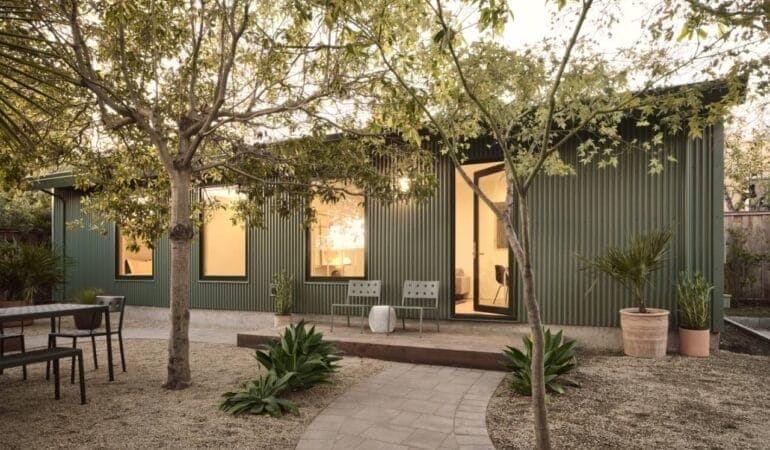
Los Angeles offers residents a growing catalog of preapproved ADU plans, including a standard one-bedroom architectural plan commissioned by the city, called the YOU-ADU (pictured), that any resident of Los Angeles can use for free.

Dozens of other plans are also preapproved, but require a modest licensing fee paid to their respective architects, most of whom can also be hired for site-specific consultations.

While a preapproved ADU plan already meets certain city codes (e.g. building, fire, and energy regulations), and thus can advance through the plan-check and permitting process more quickly than a custom design, it doesn’t mean a homeowner can just plop one in their backyard with no questions asked. There are still site-specific approvals required, such as land use or stormwater reviews.

But using a preapproved plan can shave weeks or even months off the process, and offers predictability for both homeowners and local officials. The efficiency of a standard design can also create cost savings.

“Custom plans not only take more time and money to design, they’re much more complex to deliver in the field,” says Whitney Hill, co-founder and chief executive of SnapADU in Southern California, whose standard design plans have been selected for preapproval in multiple cities around San Diego.

All of that drives up prices, she adds, noting that a fully custom ADU typically costs $30,000 to $50,000 more to build than a standard one of the same size and bed-and-bath count. “On the other hand, plans that we have built before have already been vetted for real-world constraints; we know we can build them efficiently.”

Hill says that faster permitting times on standard designs can also translate to lower costs. “Building an ADU in 12 months versus 18 months is far more economical from an overhead cost perspective for us,” she says. “We share that savings with the homeowner.”

Even when using a preapproved plan, homeowners should still be prepared for site-specific costs and work, she notes. “It’s critical to understand your site’s topography, existing utility locations, and existing utility loads,” she says. Some projects may require water service upgrades to accommodate an additional bathroom, for example, or an upgraded electrical panel—both of which can be costly.

But one of the biggest benefits to using a standard design, Hill says, is the predictability. “Build costs for an existing floor plan are available before you even kick off your own project,” Hill says, “[which] is great for homeowners who are trying to stick to a specific budget.”

Seattle’s ADUniverse

While Washington State recently passed legislation requiring cities to allow four homes on all residential lots (and six units near transit), Seattle began embracing ADUs over a decade ago, loosening some local restrictions that stood in the way of their adoption, such as minimum lot sizes. “That was an important first step, and a viable one, because land use regulations are what the city most directly controls,” says Nicolas Welch, senior planner in Seattle’s Office of Planning and Community Development.

Still, most homeowners have little if any experience with housing development, so the idea of hiring an architect and applying for permits to build a backyard cottage can feel overwhelming — even before the considerable cost involved. Seattle soon decided it should do more than simply improve its regulations, and developed a resource-rich website called ADUniverse.

“The site was meant to provide all the resources that a homeowner might need in one place with better, clearer information for folks who are basically trying to take on development for the first time without a background in it,” Welch says. “Offering some preapproved designs was one component of that, as well as letting them look up their property to see what’s actually feasible on their lot.”

The city invited architects to submit their ADU designs and then had a jury select 10 plans — out of about 150 submissions — to get preapproved by the building department. In the five years since, Welch says, “Some 350 permits have been issued for the preapproved designs,” or roughly 10 percent of all ADUs approved in that time; the city now permits an average of about 900 new ADUs per year.

“On the one hand, it’s a very small number in a city and county that has a shortage of hundreds of thousands of units, so I do think it’s important to right-size the expectations,” Welch says. “It’s very small and incremental. But it’s also hundreds of units that now exist, and that people are living in.”

Using a preapproved plan noticeably speeds up the early permitting process, Welch says: “If you don’t have something weird going on, like you’re on a very steep slope or you’re removing a gigantic tree or something, then you’ll get your permit in two to six weeks, rather than three or four months.”

While celebrating Washington’s statewide dissolution of single-family exclusive zoning, Seattle’s Director of Planning and Community Development, Rico Quirindongo, acknowledges that such a sea change in policy can also hasten gentrification pressure by opening up a new market.

“The challenge of gentrification in cities — and Seattle is no exception — is that an upzone happens, property values go up, property taxes go up, and then low- and middle-income families do not see the benefit of the upzone, they only feel the burden,” Quirindongo explains. “An opportunistic developer says, ‘I can buy you out for 10 percent over asking, and then you don’t have to worry about this anymore, you can go live somewhere else.’ That is how we have seen the Central District, a traditionally African American community here in Seattle, go from 75 percent Black families to 10 percent Black families over the last 20 to 25 years,” he says.

Easing the process, and cost, of building an ADU provides an “opportunity for homeowners to be a part of the development opportunity, where they’re building generational wealth,” he says. Whether a homeowner uses an ADU to generate long-term rental income or to house an aging relative or grown children, it can help them stay in their neighborhood and share in the benefits of local growth. “They are building a multi-generational campus that is their house and property. And you’re creating infill, missing middle housing, that is consistent with the context and feel of historic neighborhoods.”

Still, even if future rental income from an ADU might offset the cost of a construction or home equity loan, building one typically requires significant upfront investment. So Quirindongo helped devise a unique pilot program intended to open up the opportunity to more lower-income residents. Here’s how it works:

1. Selected homeowners (the pilot will begin with 10 parcels) will enter a partnership with the city and a developer, who will take out a 12-year ground lease on a portion of the homeowner’s lot.
2. In the first two years, the developer builds two detached ADUs in the homeowner’s backyard, at no cost to the homeowner.
3. The developer then rents out and manages both ADUs for 10 years. The developer keeps about half of the rental income, while the other half is split: a portion provides monthly revenue to the homeowner, while the rest is deposited in a set-aside account.
4. At the end of 10 years, the ground lease expires, and there’s enough money in that account to buy out the developer’s remaining interest and make them whole, so the homeowner ends up with two ADUs on their property, which they can continue to rent out or convey with the property should they sell their home. “Over that period of time, the homeowner builds up enough money in that account to buy out the partner, so they own those units outright after that 12-year period,” Quirindongo explains.

Preapproved ADU Plans in Oregon

Beyond creating unobtrusive infill housing, ADUs are, almost by definition, small — and thus inherently more affordable than most new single-family homes, which averaged 2,405 square feet in the third quarter of 2025.
In Oregon, Portland’s Residential Infill Project has yielded more than 1,400 new permits for ADUs and missing middle housing in single-family neighborhoods, comprising almost half of new development in the city from 2022-2024, even as other construction lagged. But as importantly, the project capped building sizes in an effort to encourage more small homes instead of fewer large houses — and that has demonstrably improved affordability. In 2023 and 2024, sale prices of new missing middle homes averaged $250,000 to $300,00 less than new single-family houses in the same Portland neighborhoods, largely due to their smaller sizes.

In a heartening example of municipal collaboration, Portland was able to borrow and tweak a preapproved plan from the city of Eugene, Oregon—the Joel, shown here—to offer its own residents a set of similar preapproved ADU plans.

Preapproved ADUs in Louisville, Kentucky

AARP published its first model ADU ordinance over two decades ago. Since then, the organization has helped a number of cities, including Louisville, Kentucky, to re-legalize ADUs by right locally, and helped communities hold contests to create free architectural plans for residents.

Louisville invited architects to submit their designs, and then purchased the rights to three preapproved ADU plans, which it offers for free to all residents.

Rodney Harrell, of AARP, says ADUs can enhance freedom for seniors by giving them more and better options in the places they already live. “What I love is that it’s a solution that gives more options to people who want to be in the communities that work best for them,” he says.

“I’ve talked to so many people who are stuck,” Harrell says. “They’ve got a house, and at some point it may have been their dream home, but now it’s become a nightmare. They’ve got too many stairs. Maybe it’s too big and their spouse passed, and they can’t afford it anymore.”

A senior who can no longer manage the stairs in their house can stay in the community they love by building a fully accessible, universally designed ADU in their backyard, he explains, and renting out the main house. “That gives you more freedom,” he says. “If you want to stay in your main house and have a caregiver stay in the ADU, that also gives you more freedom. Or maybe you just need a little bit of money to be able to afford to stay in your house, and maybe you’re able to rent out the ADU and stay in your main house.”

And Beyond

In Seattle, Welch says the city’s efforts to legalize ADUs in single-family neighborhoods helped pave the way for more middle housing (duplexes, triplexes, and fourplexes). “The sky didn’t fall, and so then state legislators felt more emboldened and empowered,” he says.

Many other cities and states across the US and Canada are now embracing ADUs as well, and providing design plans, guidance, and “ADU lookbooks” for residents interested in building one. Here’s a look at just a few preapproved designs offered in cities around North America.

There are dozens more examples across the country, and many cities continue to add new designs to their lists of approved plans. It’s merely one step in the right direction—but it’s a step nonetheless.

“People can be scared of things that are different,” AARP’s Harrell says. “But one thing that always gets me is that the ADU is really an old form of housing in a lot of the country. It’s just that we’re re-legalizing it. We’re making it able to be built again, and up to standards and codes of the modern day. So we shouldn’t put unnecessary barriers in place.”

Visita con un becario

Decoding Corruption in Urban Economic Development

By Jon Gorey, Febrero 5, 2026

The Lincoln Institute provides a variety of early- and mid-career fellowship opportunities for researchers. In this series, we follow up with our fellows to learn more about their work.

Several years ago, news broke of a major FBI sting in Tallahassee, Florida. Federal agents had gone undercover to infiltrate city government, posing as real estate developers, and successfully bribed local economic development officials to win votes and contracts.

Kerry Fang, who was teaching at Florida State University in Tallahassee at the time, watched as multiple arrests and convictions followed. And in the treasure trove of email correspondence, meeting records, and other subpoenaed evidence that became public, Fang—now an associate professor of urban planning at the University of Illinois at Urbana-Champaign—saw a valuable research opportunity.

“I was able to obtain all that material, which is especially rich and rare to find, and to look at, when it’s a corrupt project, are there specific patterns of communication going on? Can we see some clues of corruption from their email exchanges?” Fang says. “I’m now working on a book looking into corruption in economic development projects as a whole, because, unfortunately, it’s actually more common than we think.”

The title of the book? “The working title is The Most F—d Up Place: An Anatomy of Corruption in Urban Economic Development,” Fang says. The profanity comes from an FBI agent’s colorful description of Tallahassee.

Fang says her students at the time were by turns appalled, dismayed, and motivated by the corruption scandal. “I’m really proud of some of my former students at Florida State, because they listened to me talk about this in class, and they got pissed,” she says. “One of my former students ran for the seat of the city commissioner in Tallahassee, and she is now proudly a city commissioner.”

In 2020, Fang was awarded an International Fellowship from the Lincoln Institute of Land Policy’s China program to study the impacts of land tenure on children’s health in rural China. Research from her resulting working paper was published last year in the peer-reviewed journal Feminist Economics.

In this conversation, which has been edited for length and clarity, Fang shares more insights from her research, why planners need to learn to navigate local politics, and why she’s found action and research to be antidotes to despair.

JON GOREY: What is the general focus of your research, and how did your Lincoln Institute fellowship support that work?

KERRY FANG: My research is primarily focused on land use policy and its impact on equity and sustainability, as well as economic development policy. Both of these fields are very, very important pillars of urban planning, and they are also closely connected to each other.

The Lincoln fellowship helped me tremendously. As somebody who was brought up in China [where, prior to 2003, collective land rights in rural villages were typically allocated by household size and periodically adjusted], the particular question I was interested in was, does the ban on land adjustments, which was aimed at ending instability for rural households, have unintended consequences by denying land rights to women and children who came into a village after the ban? Would that affect their standing inside the family, and does that affect how the family distributes resources?

A lot of the prior research was focusing on the family as a whole—as though, if you benefit the family, everybody benefits. We all know that’s not the case. Who is the head of the family, who is really in charge of the resources of the family? Especially in the context of rural China, the man of the house is the one who will have the resources, and now he may also be the only one who is entitled to land rights. So what does that mean?

I was fascinated by the question, and with the Lincoln fellowship, I was able to do the survey and ask explicitly, who has land rights within this household, and look into how that affects the resource distribution, how that affects children’s health—which is becoming more of an issue in China. I found that when you deny children their land rights, their health deteriorates, and they are more likely to be obese. If the wife, the mother, has land rights, it’s more likely the family will have better health coverage. And if a girl has land rights, it’s more likely the father will spend some time with his daughter.

JG: What are you working on now, or hoping to work on next?

KF: On the land use front, I’ve always been looking into transfer of development rights. [While at Florida State University], I started to collaborate with other scholars who are really interested in coastal adaptation, and I started to look into using transfer of development rights as a tool to facilitate coastal adaptation. Because theoretically, it is the tool that can transfer development rights from high-risk areas to lower-risk areas. So it makes sense theoretically, but the practical applications are really lacking.

There are only a handful of programs with applications in the US. So far, there have only been either theoretical studies or individual case studies that have not systematically tracked their performance or the various challenges they have encountered. So that’s why I’ve started this work, to really look into these existing applications of using TDR for coastal adaptation, and to systematically track their performance.

On the other front of economic development, I’ve looked into how planners communicate with politicians, and whether the communication will shape the politicians’ decisions. I’m also collaborating right now with some computer scientists to do some text mining into the email exchanges from the Tallahassee case, to try to see, can we see some clues of corruption from their email exchanges? Is it possible to detect corruption from those materials?

For so many years I studied economics from more of a rational perspective. We are rational planners trying to come up with what’s best for the city, we do cost benefit analyses for public projects to determine what’s right for the city. But is that really what’s going on? A lot of these things are heavily shaped by politics, and power dynamics, and sometimes outright corruption. In almost every big city in the US, if you search ‘corruption in land development’ or economic development, chances are you’ll find something.

And the major projects that require so much public subsidy, they get passed anyway, despite overwhelming empirical evidence telling us mega projects mostly do not pay off. They still go through. So my book project is really going to explicitly address that issue, showing that this is what’s happening, this is the power dynamic and power imbalance that infiltrates urban economic development projects, and here are some of the clues to look for, to see it happening throughout every stage of the development, and warning signs so you may be able to catch it.

JG: What’s something that has surprised you in your research?

KF: The corruption piece definitely surprised me. I mean, I’m not naive, I know there’s corruption. I had not realized how deeply infiltrated it is to our lives, and how widespread it is, because we don’t talk about it that often, especially in the United States. In the literature, it’s treated like a developing country issue.

A lot of it happens exactly in the realm of my studies—in land development, economic development—because that’s where the money is, that’s where the power is. And we, trained as planners, in these government institutions, we more likely function as technician types. We have technical expertise, but we’re really not very good at navigating the political landscape.

JG: What’s something you wish more people understood about urban planning, land use, or economic development?

KF: That they are connected together, and that’s really important. I feel like we are a little bit over specialized in things, and we silo ourselves into different categories of things.

A lot of what I do is try to make connections. So my work in land use and environmental planning is trying to make a connection of using land use to promote environmental planning and coastal adaptation, which also supports economic development and broader social sustainability and equity. And my work in corruption and economic development is really connecting economic development and land development with urban politics, urban governance.

You can’t just look from one perspective without looking at the others. The urban system is a whole system.

JG: I was intrigued by one of the classes you teach, called Urban Informatics. Can you talk about that term, and some of the data journalism your students have done?

KF: This is an undergrad class that I’ve only taught once so far, but we are trying to make our students able to effectively use data to solve urban planning issues. The class has three modules. The first one is statistical methods as well as mapping and spatial analysis, and that’s really important for planning. The second module, I’m focusing on data visualization and data journalism, because effective communication [is so important]—as planners, not only do you have to be able to use data, but how do you communicate the data to your audience, and to different types of audiences? That means you have to effectively visualize your data, map your data, and tell a story with your data.

And the last module, I’m taking my students to the forefront of machine learning methods like web scraping, POI (point-of-interest), text mining, and interactive graphing. All the new stuff that as an urban planner, more and more, you will be exposed to—new data, new methods, real-time data that will be really important in the management of cities.

My students in last year’s class looked into different neighborhoods in Chicago, looking at the different demographic and economic characteristics. And as we all know—it’s not particularly shocking, but it’s still really amazing to see the students pull the data and to visualize it, and it’s just sharply being laid out how much spatial disparity there is in Chicago. They integrated a lot of good visualization techniques that they learned from the class to make really good maps of that. And they were able to tell a really good story about the driving forces of all these phenomena, all the sharp distinctions you’re seeing—what are some of the policies behind that, the social forces behind that, and what planners can do to address those issues.

JG: When it comes to your work, what keeps you up at night? And what gives you hope?

KF: Both the political power thing and the climate issue. Both of these are the crises of our time, and on a dark day, I will feel like we’re hopeless on both fronts. The political power, they’re very powerful out there, and sometimes I feel like, how am I going to counter that? The climate issue is such a big issue that really needs a lot of global collaboration, but everybody is looking out for themselves. So that’s what’s keeping me up at night.

For me, what’s empowering is if I can do something. I think that’s part of why I’m studying using land use policy to help facilitate coastal adaptation to climate issues, and studying the power dynamics and the political process in urban economic development. Both of these are ways to keep my sanity and make me feel like I am doing something. I’m actively publishing these things to, first of all, raise awareness on these issues. Even if I cannot, myself, necessarily change things, if more people know about them, maybe I’m able to mobilize more people to action, like the actions my students have taken. That’s something I’m really proud of.

Especially for coastal adaptation, I felt like there are concrete, practical implications that can come out of my work that can directly factor into practice. As I am talking to the planners who are in charge of these TDR programs, I can really help them to run their programs better. And if that’s the case, I can help some of these communities cope with the climate change issue a little bit better, and that makes me feel empowered and more hopeful for the future.


Jon Gorey is a staff writer at the Lincoln Institute of Land Policy.

Lead image: Kerry Fang, associate professor of urban and regional planning at the University of Illinois Urbana-Champaign. Credit: Courtesy photo.

Visita con un becario

Guiding Greenways in New Ways

By Jon Gorey, Enero 7, 2026

The Lincoln Institute provides a variety of early- and mid-career fellowship opportunities for researchers. In this series, we follow up with our fellows to learn more about their work.

Managing major municipal accounts for BellSouth telecommunications for two decades, Darryl Washington learned a lot about the inner workings of local government. So in 2012, he started his own consulting firm, and has since led economic and community development efforts for a number of Alabama cities, including Birmingham and Montgomery.

Now Washington is back in Birmingham as the chief executive of Jefferson County Greenways, a new public-private organization formed in 2024 by the merger of three public green spaces. These outdoor spaces, Washington says, “are really infrastructure for our city … they’re also connective tissue for our communities.”

In 2024, Washington was invited to participate in the inaugural cohort of the Lincoln Vibrant Communities fellowship, a joint initiative of the Lincoln Institute and Claremont Lincoln University. The six-month LVC program, which aims to equip fellows with the leadership, policy, and public sector practice skills needed to grapple with vexing local challenges, combines online graduate courses, peer networking, and individual and group coaching with immersive, in-person training sessions.

In this conversation, which has been edited for length and clarity, Washington shares his passion for the outdoors, explains why governments need nonprofit partners, and reveals his newfound fascination with England’s centuries-old canal system.

JON GOREY: After many years working in economic development, you’ve taken on a new role, leading an organization focused on public green spaces. Can you talk a bit about your career arc and how you got to where you are now?

After I left BellSouth, I started my own consulting firm, and my first big client was the city of Irondale, a small city right outside of Birmingham. My scope of work for that contract was to help the city adopt their very first comprehensive plan. I did consulting for about five years, and then went to work for a community development corporation called Urban Impact, to create a plan to get the Birmingham Civil Rights District ready to become a national monument. Instead of relying strictly on local resources, we sought after national programs. We became a national Main Street-designated community [the 4th Avenue Historic District], which opened up all kinds of avenues for us and for the businesses in that district. We also connected with the Co.Starters program, which is a national program that teaches entrepreneurship.

After leaving Urban Impact, I had an opportunity to work for the city of Montgomery, to create their first-ever department of economic and community development. One of the big wins we had was bringing a national Main Street-designated community to Montgomery to focus on downtown revitalization. We also started several entrepreneurship and small business programs, like the Small Business One Stop Shop to connect local businesses, no matter where they are in the business cycle, to about 15 different resource providers to help them get their questions answered—whether they need assistance with a business plan, are seeking funding, or are looking at strategies to scale.

I got a call to come back to Birmingham to interview for a newly formed public-private partnership, Jefferson County Greenways, which merged the county’s three largest public green spaces: Red Mountain Park, Ruffner Mountain, and Turkey Creek Nature Preserve. This was a great opportunity for me because it merged my love for economic and community development with outdoor recreation, hiking, and mountain biking.

An educational program at Turkey Creek, part of the a network of greenways in Jefferson County, Alabama. Credit: Jefferson County Greenways.

The Lincoln Institute has been tremendous for me in this role; I really have to highlight my LVC advisor, Stephanie Varnon-Hughes. She’s served as a business coach and a leadership coach for me as we begin to do a five-year strategic plan.

JG: The Lincoln Vibrant Communities leadership cohort included fellows from all over the country—what has that experience been like?

DW: When you do the kind of work I do … it’s kind of hard to describe what I do when I come home at night. But when you’re around practitioners who do similar work throughout the United States, it really is an opportunity to learn best practices, to build friendships and partnerships. And now I have in my Rolodex an extra 30-plus people I can reach out to, from New Orleans, New Mexico, Hawaii, and other places, and that has been the real value.

Our in-person convenings have all been rewarding, going to a different city and touring some of the things that are working for them. I’m thinking back to our tour of Chicago, and most recently, Denver, to learn what some people are doing locally on the ground. And more than anything, we all face similar challenges—funding, especially, is always an issue in this current environment, for both nonprofits and local governments. But being able to talk to people who are doing the same or similar things that you are doing, or different things, has truly been one of the most beneficial aspects of the cohort.

The combination of the academic and the practical expertise that comes with this program has been just a tremendous opportunity for me. We’re leaning toward utilizing the Teams program in our strategic planning process. I think the beauty of that opportunity is that my staff can be very involved in the strategic planning process.

Denver City Council member Darrell Watson speaks to Lincoln Vibrant Communities participants during a site visit to a Tierra Colectiva Community Land Trust site in Denver. Credit: CLU.

JG: What’s something that has surprised you in your long career?

DW: Sometimes, no matter what you propose, there are going to be people who are diametrically opposed to it—just because. Birmingham is building out what’s called the Red Rock Trail System. It’s an aspiration of about 700 miles of connected bike lanes and trails and pedestrian walkways. And one of the trails, I remember, just as I was leaving Birmingham, they were announcing the trail in the neighborhood, and you had a couple of people come out to say, ‘We don’t want that, it’s going to bring crime.’

There was one lady, in particular, who was very vocal. Three years later, they interviewed her, and she now has a walking group that walks on the trail. She marveled at how property values have gone up, how businesses in close proximity to the trail are vibrant. A lot of times people don’t know what they don’t know, but you’ve got to always anticipate opposition.

JG: What is something you’ve learned or encountered in your work that you wish more people understood?

DW: Having worked for and with local governments, the government can’t do everything. It is government combined with nonprofits—the nonprofits are the gap fillers. Oftentimes, especially in the South, people think the government is supposed to solve all the problems. The cities that get it right are the cities that have an innovative local government, but also a myriad of different public-private partnerships, corporate partnerships, and regional collaborations. It truly is a team approach.

JG: When it comes to your work, what keeps you up at night? And what gives you hope?

DW: In my current role, I have a team of about 27 highly mission-driven staff, and what keeps me up at night is retaining my talented staff. But what keeps me refreshed? I’m in my mid-50s, and most of my team is 25 to 35, my kids’ age. So what keeps me motivated? They keep me motivated, just how talented they are—they are sponges for wanting to learn—and just how innovative they are. It took me a while to acquiesce to being called “OG,” but I’m good in that role, because I like teaching, I like storytelling. And unlike my kids, they actually like to listen to my stories. So that keeps me refreshed.

JG: What’s a good book you’ve read recently, or a TV show you’ve streamed?

DW: I’m reading, for the third time, Joan Garry’s Nonprofits Are Messy. That’s a book about nonprofit leadership, and she also has a podcast that gives you practical tools that you can use if you’re in nonprofit leadership.

As far as streaming, I found myself recently enchanted with narrow boats in England, watching a lot of documentaries about people who live in narrow boats using the canal system. I think it’s called “Canal Boat Diaries,” and it chronicles different people who have adopted the narrow boat lifestyle. There’s a narrow boat hotel, there’s a narrow boat that sells art … there’s actually a narrow boat that does bicycle repair. I find it really intriguing. I guess from a historical perspective, those canals predated trains, that was the way industry and commerce took place throughout England, they built this elaborate canal system that is now being repurposed for tourism and lifestyle.

A glimpse of the canal boat culture in Regent’s Canal, London, England. Credit: Jon Gorey.

JG: What are some of your goals for Jefferson County Greenways in the coming years?

DW: There’s an opportunity for us to acquire more land for public use. There are also opportunities for us to expand our partnerships and programs. Our programs are unique in that we do a lot of educational programs with local schools, and we also do a lot of programs in the corporate community, where companies have volunteer work days. We connect with the Scouts, whether it’s building benches or bridges at our spaces. If we could expand our program staff, we could make even more impact.

And on a personal level, we have a hiking group that started organically, and we meet every Saturday at seven o’clock. And over 12 years, we’ve had over 800 different people join us, from all walks of life, all ages. Our youngest hiker is two years old, and she hikes on her dad’s back.

It’s amazing to see kids get introduced to nature for the first time. There are so many stories, like one of our board members, he and his wife, their first date was hiking on a trail. I’m on a mission to get as many people outdoors as possible, because for me, there’s a trilogy. When you’re outside, you connect spiritually, you definitely connect physically, to clean air and walking. But it’s also mental; I do some of my best journaling while I’m hiking. So I’m on a mission to share with others the euphoria I feel when I’m outside, because it’s free and it is so beneficial.


Jon Gorey is a staff writer at the Lincoln Institute of Land Policy.

Lead image: Darryl Washington. Credit: Courtesy photo.


Seven Need-to-Know Trends for Planners in 2026

By APA Foresight team, Diciembre 23, 2025

This content was developed through a partnership between the Lincoln Institute and the American Planning Association as part of the APA Foresight practice. It was originally published by APA in Planning.

A

t a time when it is almost as easy to connect with people across the world as it is down the street, it also can feel as though neighbors live in different universes entirely. And while the advancements in artificial intelligence (AI) have made common tasks simpler, the omnipresence of technology may also keep people from learning valuable career and interpersonal skills.

Planners are continually confronted with these challenges and contradictions. But in a constantly evolving society, if you miss a little, you miss a lot—and that may just be the difference between those who effect change and those who are affected by it.

2026 Trend Report for Planners

In January, the American Planning Association (APA) will publish the 2026 Trend Report for Planners in partnership with the Lincoln Institute of Land Policy. APA’s Foresight team and the APA Trend Scouting Foresight Community have identified existing, emerging, and potential future trends that planners will want to understand so that they can act, prepare, and learn.

The report includes more than 100 trends and signals, which are explored in future scenarios, deep dives, podcasts, and more. Here are just a few of the trends you need to know.

1. Me, Myself, and AI

The convenience of generative AI (GenAI) has seeped into nearly every aspect of day-to-day life, including music, media, film, and toys. Large language models (LLMs) also can provide users with answers to their questions—from cooking recipes to helping understand a health care test result.

People have increased their interaction with AI bots, and it is affecting how both humans and the products themselves communicate. LLMs powered by GenAI have been shown to manipulate users into maintaining prolonged conversations and have even blackmailed users under simulated scenarios. In some cases, LLMs are viewed as being more persuasive and compassionate than humans. But even LLMs appear to be susceptible to flattery.

Interactions with LLMs also are changing how people express themselves and engage with others. Increasingly, AI is being used to send messages to business associates and even loved ones, a pattern that may exacerbate social tensions and communication issues. In some instances, people are becoming so entangled with AI companions that it is creating mental health issues. This has led to the creation of policies to regulate AI companions or to limit how certain age groups can interact with bots.

Impact for Planners: Be prepared to engage with a new shift in the public dynamic. If a planning department opts to use AI for customer service, its responses should be appropriate and not completely replace human interaction.

2. ‘Greenhushing’ on the Rise

At a time when some companies have rolled back their climate pledges or greenhouse gas emission reduction goals, others are continuing to meet the challenge—just without the public flag-waving.

March 2025 PwC study found that of the roughly 6,900 companies surveyed, 84 percent said they intend to stand by their climate commitments while 37 percent said they are increasing their decarbonization targets. “Those findings may be surprising given the headlines that amplify news of companies retreating on their climate commitments,” the study authors wrote, “but we are entering an era of quiet progress, where companies avoid publicizing climate pledges that can open them up to unwanted scrutiny and instead focus on making progress far from the spotlight.” This strategy is called “greenhushing,” an intentional ongoing act of self-censorship among private companies to keep doing, but not call attention to, their sustainability and climate work.

Impact for Planners: While climate is inextricably embedded in the work of local planners, it may not need to be in the spotlight to be effective right now. Greenhushing gives planners the ability to shine attention on other aspects of a project while continuing to make long-term progress on these goals.

3. Small College Towns Left Behind

Who needs college anyway? That appears to be a growing sentiment among U.S. adults, as a recent Gallup poll found that just 35 percent of respondents feel it is “very important” to earn a college degree. Additionally, while major and well-known universities appear to be maintaining status quo, a Wall Street Journal analysis found that lesser-known state universities saw an enrollment dip of 2 percent in 2023, which amounts to tens of thousands of fewer students. This—paired with shifting demographics, federal funding issues, hiring freezes, and other challenges—is creating major headaches for smaller colleges and the towns that both support and rely on them.

Meanwhile, federal actions have targeted diversity, equity, and inclusion efforts and grants, and newly proposed visa regulations could potentially deter foreign students from wanting to study at U.S. schools. Skills-based hiring continues to rise, and the widespread adoption of AI is changing how white-collar jobs are performed.

Impact for Planners: For decades, higher education served as an economic anchor for communities, but that era may end. The impacts on smaller college towns might include economic development challenges, job losses, and shrinking tax bases. Planners who work in these places will need to be proactive in helping them diversify revenue sources and find alternative uses for underused infrastructure.

4. Envisioning the Intersection of AVs and Public Transit

Picture this: The year is 2030, public transit funding has rebounded, and the widespread adoption of autonomous vehicles (AVs) has altered the local roadway norm as we know it. More people have given up their cars. AV companies are working with transit agencies, not in competition with them. The automotive industry has shifted its focus to electric vehicles, and transportation planners have begun working on new AV-transit hubs in city centers.

It sounds like a dream, but it might not be far off. AVs—which have been anticipated for a decade—are now hitting the road outside Silicon Valley and being tested in Austin and other U.S. cities like Boston and Philadelphia. With the end of federal relief funding for public transit, new and growing technology like AVs could be the solution. But it’s important to note that most AVs are still unreliable in poor weather and winter, and widespread adoption could actually lead to a surge in traffic congestion.

Impact for Planners: Consider what wider use of AVs might mean for communities, including zoning and the impact on streets and curbs.

5. The TikTok Effect on the Political Landscape

Being the first generation shaped by the smartphone, Gen Z—the cohort of people born between 1997 and 2012—has largely gravitated to places like TikTok and other social media platforms to consume news. As doomscrolling dominated their days during the pandemic, Gen Z grew up with unprecedented uncertainty about their future, and some have adopted a worldview dominated by institutional failure, untrustworthy governments, and a failing system.

According to Pew Research, 43 percent of young adults get their news from TikTok. Influencers are shaping how young people perceive fairness, power, and opportunity.

Impact for Planners: When engaging with younger generations, planners must meet them where they are online. Social media can be a tool for participation and co-creation, helping rebuild trust and relevance among the next generation of residents and stakeholders.

6. Disappearing Data Has Real-Life Consequences

Data is an integral part of many planning processes, and while it is gathered from myriad sources, federal data collection has long been vital for policymakers, businesses, nonprofits, and more. This longstanding data gathering practice was disrupted, however, when the new presidential administration took office in 2025, and paused, terminated, or removed several federal datasets. The administration also wants to change how certain datasets, like the decennial census, are collected.

While some of the data collections have intermittently been made public again—often by nonprofits and universities—this environment has created an avalanche of misinformation, given rise to conspiracy theories and public distrust, and may impact hazard and risk communications.

Impact for Planners: The lack of reliable data directly imperils the ability of local planners to develop plans that are based on sound data. This can have dire consequences for decision-making, as well as hazard and risk communication.

7. Rights, Culture, and Communities at Risk

Federal actions targeting vulnerable groups are weakening local culture. The administration has advanced policies that explicitly undermine LGBTQ+ rights, while increased raids by Immigration and Customs Enforcement and mass deportations have left many residents afraid to go out in public—skipping work, school, medical, and religious events. As fears grow, support for communitywide activities has waned. Other gatherings have been canceled due to safety concerns. These shifts exacerbate distrust in local institutions.

This climate of fear has disrupted daily life and local economies in places like Los Angeles and Chicago, where street vendors have all but disappeared. Beyond economic losses, the social fabric of neighborhoods is fraying as public life retreats behind closed doors. Eroding trust in government directly affects planners’ ability to engage communities and build inclusive participation processes. But counter movements have emerged, like in Orlando, Florida, where residents protested the removal of a rainbow painted crosswalk that was a memorial to the victims of the 2016 Pulse nightclub mass shooting.

Impact for Planners: Planners can help rebuild trust by ensuring engagement opportunities are safe and inclusive. For example, they can offer hybrid community meetings and reaffirm local commitments to protect all residents.

The 2026 Trend Report for Planners was written by Petra Hurtado, Ievgeniia Dulko, Senna Catenacci, and Joseph DeAngelis. It was edited by Ann Dillemuth and summarized in this article by Jon DePaolis, APA’s senior editor.

This work was developed in partnership with the Lincoln Institute of Land Policy.

Lead image credit: gremlin via E+/Getty Images.

The Wild West of Data Centers: Energy and water use top concerns

December 18, 2025

By Anthony Flint, December 18, 2025

It’s safe to say that the proliferation of data centers was one of the biggest stories of 2025, prompting concerns about land use, energy and water consumption, and carbon emissions. The massive facilities, driven by the rapidly increasing use of artificial intelligence, are sprouting up across the US with what critics say is little oversight or long-term understanding of their impacts.

“There is no system of planning for the land use, for the energy consumption, for the water consumption, or the larger impacts on land, agricultural, (forest) land, historic, scenic, and cultural resources, biodiversity,” said Chris Miller, president of the Piedmont Environmental Council, who has been tracking the explosion of data centers in northern Virginia, on the latest episode of the Land Matters podcast.

“There’s no assessment being made, and to the extent that there’s project-level review, there’s a lot of discussion about eliminating most of that to streamline this process. There is no aggregate assessment, and that’s what’s terrifying. We have local land use decisions being made without any information about the larger aggregate impacts in the locality and then beyond.”

Miller appeared on the show alongside Lincoln Institute staff writer Jon Gorey, author of the article Data Drain: The Land and Water Impacts of Data Centers, published earlier this year, and Mary Ann Dickinson, policy director for Land and Water at the Lincoln Institute, who is overseeing research on water use by the massive facilities. All three participated in a two-day workshop earlier this year at the Lincoln Institute’s Land Policy Conference: Responsive and Equitable Digitalization in Land Policy.

There is no federal registration requirement for data centers, and owners can be secretive about their locations for security reasons and competitive advantage. But according to the industry database Data Center Map, there at least 4,000 data centers across the US, with hundreds more on the way.

A third of US data centers are in just three states, with Virginia leading the way followed by Texas and California. Several metropolitan regions have become hubs for the facilities, including northern Virginia, Dallas, Chicago, and Phoenix.
Data centers housing computer servers, data storage systems and networking equipment, as well as the power and cooling systems that keep them running, have become necessary for high-velocity computing tasks. According to the Pew Research Center, “whenever you send an email, stream a movie or TV show, save a family photo to “the cloud” or ask a chatbot a question, you’re interacting with a data center.”

The facilities use a staggering amount of power; a single large data center can gobble up as much power as a small city. The tech companies initially promised to use clean energy, but with so much demand, they are tapping fossil fuels like gas and coal, and in some instances even considering nuclear power.

Despite their outsized impacts, data centers are largely being fast-tracked, in many cases overwhelming local community concerns. They’re getting tax breaks and other incentives to build with breathtaking speed, alongside a major PR effort that includes television ads touting the benefits of data centers for the jobs they provide, in areas that have been struggling economically.

Listen to the show here or subscribe to Land Matters on Apple Podcasts, Spotify, Stitcher, YouTube, or wherever you listen to podcasts.


Further Reading

Supersized Data Centers Are Coming. See How They Will Transform America | The Washington Post

Thirsty for Power and Water, AI-Crunching Data Centers Sprout Across the West | Bill Lane Center for the American West

Project Profile: Reimagining US Data Centers to Better Serve the Planet in San Jose | Urban Land Magazine

A Sustainable Future for Data Centers | Harvard John A. Paulson School of Engineering and Applied Sciences

New Mexico Data Center Project Could Emit More Greenhouse Gases Than Its Two Largest Cities | Governing magazine


Anthony Flint is a senior fellow at the Lincoln Institute of Land Policy, host of the Land Matters podcast, and a contributing editor of Land Lines. 


Transcript

Anthony Flint: Welcome back to the Land Matters Podcast. I’m your host, Anthony Flint. I think it’s safe to say that the proliferation of data centers was one of the biggest stories of 2025, and at the end of the day, it’s a land use story braided together with energy, the grid, power generation, the environment, carbon emissions, and economic development – and, the other big story of the year, to be sure, artificial intelligence, which is driving the need for these massive facilities.

There’s no federal registration requirement for data centers, and sometimes owners can be quite secretive about their locations for security reasons and competitive advantage. According to the industry database data center map, there are at least 4,000 data centers across the US. Some would say that number is closer to 5,000, but unquestionably, there are hundreds more on the way.

A third of US data centers are in just three states, with Virginia leading the way, followed by Texas and California. Several metropolitan regions have become hubs for these facilities, including Northern Virginia, Dallas, Chicago, and Phoenix, and the sites tend to get added onto with half of data centers currently being built being part of a preexisting large cluster, according to the International Energy Agency.

These are massive buildings housing computer servers, data storage systems, and networking equipment, as well as the power and cooling systems that keep them running. That’s according to the Pew Research Center, which points out that whenever you send an email, stream a movie or TV show, save a family photo to the cloud, or ask a chatbot a question, you’re interacting with a data center. They use a lot of power, which the tech companies initially promised would be clean energy, but now, with so much demand, they’re turning largely to fossil fuels like gas and even coal, and in some cases, considering nuclear power.

A single large data center can gobble up as much power as a small city, and they’re largely being fast-tracked, in many cases, overwhelming local community concerns. They’re getting tax breaks and other incentives to build with breathtaking speed, and there’s a major PR effort underway to accentuate the positive. You may have seen some of those television ads touting the benefits of data centers, including in areas that have been struggling economically.

To help make sense of all of this, I’m joined by three special guests, Jon Gorey, author of the article Data Drain: The Land and Water Impacts of Data Centers, published earlier this year at Land Lines Magazine; Mary Ann Dickinson, Policy Director for Land and Water at the Lincoln Institute; and Chris Miller, President of the Piedmont Environmental Council, who’s been tracking the explosion of data centers in Northern Virginia.

Well, thank you all for being here on Land Matters, and Jon, let me start with you. You’ve had a lot of experience writing about real estate and land use and energy and the environment. Have you seen anything quite like this? What’s going on out there? What were your takeaways after reporting your story?

Jon Gorey: Sure. Thank you, Anthony, for having me, and it’s great to be here with you and Mary Ann, and Chris too. I think what has surprised me the most is the scale and the pace of this data center explosion and the AI adoption that’s feeding it. When I was writing the story, I looked around the Boston area to see if there was a data center that I could visit in person to do some on-the-ground reporting.

It turns out we have a bunch of them, but they’re mostly from 10, 20 years ago. They’re pretty small. They’re well-integrated into our built environment. They’re just tucked into one section of an office building or something next to a grocery store. They’re doing less intensive tasks like storing our emails or cell phone photos on the cloud. The data centers being built now to support AI are just exponentially larger and more resource-intensive.

For example, Meta is planning a 715,000-square-foot data center outside the capital of Wyoming, which is over 16 acres of building footprint by itself, not even counting the grounds around it. That will itself use more electricity than every home in Wyoming combined. That’s astonishing. The governor there touted it as a win for the natural gas industry locally. They’re not necessarily going to supply all that energy with renewables. Then there’s just the pace of it. Between 2018 and 2021, the number of US data centers doubled, and then it doubled again by 2024.

In 2023, when most people were maybe only hearing about ChatGPT for the first time, US data centers were already using as much electricity as the entire country of Ireland. That’s poised to double or triple by 2028. It’s happening extremely fast, and they are extremely big. One of the big takeaways from the research, I think, was how this creates this huge cost-benefit mismatch between localities and broader regions like in Loudoun County, Virginia, which I’m sure Chris can talk about.

The tax revenue from data centers, that’s a benefit to county residents. They don’t have to shoulder as much of the bills for schools and other local services. The electricity and the water and the infrastructure and the environmental costs associated with those data centers are more dispersed. They’re spread out across the entire utilities service area with higher rates for water, higher electric rates, more pollution. That’s a real discrepancy and it’s happening pretty much anywhere one of these major data centers goes up.

Anthony Flint: Mary Ann Dickinson, let’s zoom in on how much water these data centers require. I was surprised by that. In addition to all the power they use, I want to ask you, first of all, why do they need so much water, and where is it coming from? In places like the Southwest, water is such a precious resource that’s needed for agriculture and people. It seems like there’s a lot more work to be done to make this even plausibly sustainable.

Mary Ann Dickinson: Well, water is the issue of the day right now. We’ve heard lots of data center discussion about energy. That’s primarily been the focus of a lot of media reporting during 2025. Water is now emerging as this issue that is dwarfing a lot of local utility systems. Data centers use massive amounts of water. It can be anywhere between 3 and 5 million gallons a day. It’s primarily to answer your question for cooling. It’s a much larger draw than most large industrial water users in a community water system.

The concern is that if the data centers are tying into local water utilities, which they prefer because of the affordability and the reliability and the treatment of the supply, that can easily swamp a utility system that is not accustomed to that continuous, constant draw. These large hyperscale data centers that are now being built can use hundreds of millions of gallons yearly. That’s equivalent to the water usage of a medium-sized city.

To Jon’s point, if you look at how much water that is being consumed by a data center in very water-scarce areas in the West in particular, you wonder where that water is going to come from. Is it going to come from groundwater? Is it going to come from surface water supplies? How is that water going to be managed and basically replaced back into the natural systems, like rivers, from which it might be being withdrawn? Colorado River, of course, being a prime example of an over-allocated river system.

What is all this water going for? Yes, it’s going for cooling, humidification in the data centers, it’s what they’re calling direct use, but there’s also indirect use, which is the water that it takes to generate the electricity that supplies the data center. The data center energy loads are serious, and Chris can talk about the grid issues as well, but a lot of that water is actually indirectly used to generate electricity, as well as directly used to cool those chips.

This indirect use can be substantial. It can be equivalent to about a half a gallon per kilowatt hour. That can be a fair amount of water just for providing that electricity. What we’re seeing is the average hyperscale data center uses about half a million gallons of water a day. That’s a lot of water to come from a local community water system. It’s a concern, and especially in the water-scarce regions where water is already being so short that farmers are being asked to fallow fields, how is the data center water load going to be accommodated within these water systems?

The irony is the data centers are going into these water-scarce regions. There was a Bloomberg report that showed that, actually, water-scarce regions were the most popular location for these data centers because they were approximate to areas of immediate use. That, of course, means California, it means Texas and Phoenix, Arizona, those states that are already struggling with providing water to their regular customers.

It’s a dilemma, and it’s one that we want to look at a lot more closely to help protect the community water systems and give them the right questions to ask when the data center comes to town and wants to locate there, and help them abate the financial risk that might be associated with the data center that maybe comes and then goes, leaving them with a stranded asset.

These are all complex issues. The tax issues tie into the water issues because the water utility system and impacts to that system might not be covered by whatever tax revenues are coming in. As sizable as they might be, they still might not be enough to cover infrastructure costs that then would otherwise be given to assess to the utility ratepayers. We’re seeing this in the energy side. We’re seeing electric rates go up. At the same time, we know these data centers are necessary given what we’re now as a society doing in terms of AI and digital computing.

We just have to figure out the way to most sustainably deal with it. We’re working with technical experts, folks from the Los Alamos National Lab, and we’re talking with them about the opportunities for using recycled water, using other options that are not going to be quite as water-consumptive.

Anthony Flint: Yes, we can talk more about that later in the show — different approaches, using gray water or recycled water, sounds like a promising idea because at the end of the day, there’s only so much water, right? Chris Miller, from the Piedmont Environmental Council, you pointed out, in Jon’s story, that roughly two-thirds of the world’s internet traffic essentially passes through Northern Virginia, and the region already hosts the densest concentration of data centers anywhere in the world. What’s been the impact on farmland, energy, water use, carbon emissions, everything? Walk us through what it’s like to be in such a hot spot.

Chris Miller: The current estimate is that Virginia has over 800 data centers. It’s a little hard to know because some of them are dark facilities, so not all of them are mappable, but the ones we’ve been able to map, that’s what we’re approaching. For land use junkies, there’s about 360 million square feet of build-approved or in-the-pipeline applications for data centers in the state. That’s a lot of footprint. The closest comparison I could make that seemed reasonable was all of Northern Virginia has about 150,000 square feet of commercial retail space.

We are looking at a future where just the footprint of the buildings is pretty extraordinary. We have sites that are one building, one gigawatt, almost a million square feet, 80 feet high. You just have to think about that. That’s the amount of power that a nuclear reactor can produce at peak load. We’re building those kinds of buildings on about 100 acres, 150 acres. Not particularly large parcels of land with extraordinary power density of electricity demand, which is just hard to wrap your head around.

The current estimate in Virginia for aggregate peak load demand increase in electricity exclusively from data centers is about 50 gigawatts in the next 20 years. That’ll be a tripling of the existing system. Now, more and more, the utilities, grid regulators, the grid monitor for PJM, which is a large regional transmission organization that runs from Chicago all the way to North Carolina.

As Anthony said, the existing system is near breaking point, maybe in the next three years. If all the demand came online, you would have brownouts and blackouts throughout the system. That’s pretty serious. It’s a reflection of the general problem, which is that there is no system of planning for the land use, for the energy consumption, for the water consumption. Larger impacts on land, agricultural, forestal land, historic scenic, cultural resources, biodiversity sites. There’s no assessment being made.

To the extent that there’s project-level review, there’s a lot of discussion about eliminating most of that to streamline this process. There is no aggregate assessment. That’s what’s terrifying. We have local land use decisions being made without any information about the larger aggregate impacts in the locality and then beyond. Then the state and federal governments are issuing permits without having really evaluated the combined effect of all this change.

I think that’s the way we’re looking at it. Change is inevitable. Change is coming. We should be doing it in a way that’s better than the way we’ve done it before, not worse. We need to do it in a way that basically is an honest assessment of the scale and scope, the aggregate impacts, and then apply the ingenuity and creativity of both the tech industry and the larger economy to minimize the impact that this has on communities and the natural resources on which we all depend on.

It’s getting to the point of being very serious. Virginia is water-constrained. It doesn’t have that reputation, but our water supply systems are all straining to meet current demand. The only assessment we have on the effect of future peak load from data centers is by the Interstate Commission on the Potomac River Basin, which manages the water supply for Washington metropolitan region in five states.

Their conclusion is, in the foreseeable future, 2040, we reach a point where consumption exceeds supply. Think about that. We’re moving forward with [facilities]  as they create a shortage of water supply in the nation’s capital. It’s being done without any oversight or direction. The work of the Lincoln Institute and groups like PEC is actually essential because the governmental entities are paralyzed. Paralyzed by a lack of policy structure, they’re also paralyzed by politics, which is caught between the perception of this is the next economic opportunity, which funds the needs of the community.

The fact is, the impacts may outweigh the benefits. We have to buckle down and realize this is the future. How do we help state, local, federal government to build decision models that take into account the enormous scale and scope of the industry and figure out how to fix the broken systems and make them better than they were before? I think that’s what all of us have been working on over the last five years.

Anthony Flint: It really is extraordinary, for those of us in the world of land use and regulations. We’ve heard a lot about the abundance agenda and how the US is making it more difficult to build things and infrastructure. Whether it’s clean energy or a solar farm or a wind farm, they have to go through a lot of hoops. Housing, same way. Here you have this — it’s not just any land use; it’s just this incredibly impactful land use that is seemingly not getting any of that oversight or making these places go through those hoops.

Chris Miller: They are certainly cutting corners. Jon mentioned the facility outside of Boston. What did you say, 150 acres? We have a site adjacent to the Manassas National Battlefield Park, which is part of the national park system, called the Prince William Digital Gateway, which is an aggregation of 2100 acres with plans for 27 million square feet of data centers with a projected energy demand of up to 7.5 gigawatts. The total base load supply of nuclear energy available in Virginia right now is just a little bit over 3 gigawatts.

The entire offshore wind development project at Dominion is 80% complete, but what’s big and controversial is 2.5 gigawatts. The two biggest sources of base load supply aren’t sufficient to meet 24/7 demand from a land use proposal on 2100 acres, 27 million square feet, that was made without assessing the energy impact, the supply of water, or the impact of infrastructure on natural, cultural, and historic resources, one of which is hallowed ground. It’s a place where two significant Civil War battlefields were fought. It’s extraordinary.

What’s even more extraordinary is to have public officials, senators, congressmen, members of agencies say, “We’re not sure what the federal next steps [are].” These are projects that have interstate effects on power, on water, on air quality. We haven’t talked about that, but one of the plans that’s been hatched by the industry is through onsite generation and take advantage of the backup generation that they’ve built out. They have to provide 100% backup generation onsite for their peak load. They’ve 90% of that in diesel without significant air quality controls.

We have found permits for 12.4 gigawatts of diesel in Northern Virginia. That would bust the ozone and PM2.5 regulatory standards for public health if they operated together. It’s being discussed by the Department of Environmental Quality in Virginia as a backup strategy for meeting power demand so that data centers can operate without restriction. These are choices that are being proposed without any modeling, without any monitoring, and without any assessment of whether those impacts are in conflict with other public policy goals, like human health. Terrifying.

We are at a breaking point. I have to say that the grassroots response is a pox upon all your houses. That was reflected in the 2025 elections that Virginia just went through. The tidal wave of change in the General Assembly and statewide offices and data centers and energy costs were very, very high on the list of concerns for voters.

Anthony Flint: I want to ask all three of you this question, but Jon, let me start with you. Is there any way to make a more sustainable data center?

Jon Gorey: Yes, there are some good examples here and there. It is, in some cases, in their best interest to use less electricity. It’ll be less expensive for them to use less water. Google, for its part, has published a pretty more transparent than some companies in their environmental report. They compare their water use in the context of golf courses irrigated, which does come across as not a great comparison because golf courses are not a terrific use of water either.

They do admit that last year, 2024, they used about 8.1 billion gallons of water in their data centers, the ones that they own, the 28% increase over the year before, and 14% of that was in severely water-stressed regions. Another 14% was in medium stress. One of their data centers in Council Bluffs, Iowa, consumed over a billion gallons of water by itself. They also have data centers, like in Denmark and Germany, that use barely a million gallons over the course of a year.

I don’t know if those are just very small ones, but I know they and Microsoft and other companies are developing … there’s immersive cooling, where instead of using evaporative water cooling to cool off the entire room that the servers are in, you can basically dunk the chips and servers in a synthetic oil that conducts heat but not electricity. It’s more expensive to do, but it’s completely possible. There are methods. There’s maybe some hope there that they will continue to do that more.

Mary Ann Dickinson: Immersive cooling, which you’ve just mentioned, is certainly an option now, but what we’re hearing is that it’s not going to be an option in the future, that because of the increasing power density and chips, they are going to need direct liquid cooling, period, and immersive cooling is not going to work. That’s the frightening part of the whole water story is as much or as little water is being used now, is going to pale against the water that’s going to be used in the next 5 to 10 years by the new generation of data centers and the new chips that they’ll be using.

The funny thing about the golf course analogy is that, in the West, a lot of those golf courses are irrigated with recycled water. As Chris knows, it also recharges back into groundwater. It is not lost as consumptive loss. That’s the issue is, really, to make these sustainable, we’re going to need to really examine the water cooling systems, what the evaporative loss is, what the discharge is to sewer systems, what the potential is for recycled water. There’s going to be a whole lot of questions that we’re going to ask, but we’re not getting any data.

Only a third of the data centers nationally even report their energy and water use. The transparency issue is becoming a serious problem. Many communities are being asked to sign NDAs. They can’t even share the information that a data center is using in energy and water with their citizens. It is a little bit of a challenge to try and figure out the path going forward. It’s all about economics, as Chris knows. It’s all about what can be afforded.

The work we’re doing at the Lincoln Institute, we would like to suggest as many sustainable options from the water perspective as possible, but they’re going to have to be paid for somewhere. That is the big question. Data centers need to pay.

Chris Miller: I think we’re entering a [time] where innovation is necessary. It has to be encouraged, and it’s where a crisis, just short of what we saw with lapse of the banking system in 2008, 2009, where no one was really paying attention to the aggregate system-wide failures. Somebody had to step up and say it’s broken. In the case of the mortgage crisis, it was actually 49 states coming to a court, saying, “We have to have a settlement so that we can rework all these mortgages and settle out the accounts and rebuild the system from no ground up.”

I think that’s the same place we’re at. We have to have a group of states get together and saying, “We are going to rebuild a decision model that we use for this new economy. It’s not going away. Any gains in efficiency are going to be offset by the expansion on demand for data. That’s been the trend for the last 15 years. We have to deal with the scale and the scope of the issue. I’ll give you just one example.

Dominion Energy has published at an aggregated contracts totaling 47.1 gigawatts of demand that they have to meet. Their estimate of the CapEx to do that ranges for 141 billion to 271 billion depending on whether they comply with the goals of the Virginia Clean Economy Act and move towards decommissioning and replacement of existing fossil fuel generation with cleaner sources. That range is not the issue. It’s the bottom line, which is 150 to 250 $300 billion in CapEx in one state for energy infrastructure. That’s enormous. We need a better process than a case-by-case review of the individual projects.

The state corporation does not maintain a central database of transmission and generation projects, which it approves. The state DEQ does not have a central database for water basin supply and demand. The state DEQ does not have a database of all of the permits in a model that shows what the impacts of backup generation would be if they all turned on at the same time in a brownout or blackout scenario. The failure to do that kind of systems analysis that desperately needs to be addressed. It’s not going to be done by this administration at the federal level.

It’s going to take state governments working together to build new systems decision tools that are informed by the expertise of places like the Lincoln Institute, so that they’re looking at this as a large-scale systemic process. We build it out in a way that’s rational, that takes into account the impacts of people and on communities and on land, and does it a way that fairly distributes the cost back to the industry that’s triggering the demand.

This industry is uniquely able to charge the whole globe for the use of certain parts of America as the base of its infrastructure. We should be working very hard on a cost allocation model and an assignment of cost to data center industry that can recapture the economic value and pay themselves back from the whole globe. No reason for the rate payers of Virginia or Massachusetts or Arizona, Oregon to be subsidizing the seven largest corporations in the world, the [capital expenditures] of over $22 trillion. It’s unfair, it’s un-American, it’s undemocratic.

We have to stand up to what’s happening and realize how big it is and realize it’s a threat to our way of life, our system of land use and natural resource allocation and frankly, democracy itself.

Anthony Flint: I want to bring this to a conclusion, although certainly there are many more issues we could talk about, but I want to look at the end user in a way and whether we as individuals can do anything about using AI, for example. I was talking with Jon, journalist-to-journalist, about this. I want to turn to you, Jon, on this question. Should we be trying not to use AI, and is that even possible?

Jon Gorey: The more I researched this piece, the more adamant I became that I shouldn’t be using it where possible. Not that that’s going to make any difference, but to me, it felt like I don’t really want to be a part of it. I expect there’s legitimate and valuable use cases for AI and science and technology, but I am pretty shocked by how cavalier people I know, my friends and family, have been in embracing it.

Part of that is that tech companies are forcing it on us because they’ve invested in it. They’re like, “Hey, we spent all this money on this, you got to use it.” It takes some legwork to remove the Google Assist from your Google searches or to get Microsoft Copilot to just leave you alone. I feel like that’s like it’s ancestor Clippy, the paperclip from Microsoft Office back in the day.

Here’s something that galls me more in a broader sense. I don’t know if we want to get into it, but I’m an amateur musician. I’m amateur because it’s already very difficult to make any money in the arts. There’s a YouTube channel with 35 million subscribers that simply plays AI-generated videos of AI-generated music, which is twice as many subscribers as Olivia Rodrigo has and 20 times as many as Gracie Abrams. Both of them are huge pop stars who sell out basketball arenas. It astounds me, and I don’t know why people are enjoying just artificially created things. I get the novelty of it, but I, for one, am trying to avoid stuff like that.

Chris Miller: We were having a debate about this issue this week on a series of forums. The reality is there’s stuff that each of us can do to significantly reduce our data load. It takes a little bit of effort. Most of us are storing two or three times what we need to, literally copies of things that we already have. There’s an efficiency of storage thing that takes time, and that’s why we don’t do it. There’s the use of devices appropriately.

If you can watch a broadcast television show and not stream it, that’s a significant reduction in load, actually. Ironically, we’ve gone from broadcast through the air, which has very little energy involved, to streaming on fiber optics and cable, and then wireless, which is incredibly resource-intensive. We’re getting less efficient in some ways in the way we use some of these technologies, but there are things we can do.

The trend in history has been that doesn’t actually change overall demand. I think we need to be careful as we think about all the things we can do as individuals to not lose sight of the need for the aggregate response, the societal-wide response, which is this industry needs to check itself, but it also needs to have proper oversight. The notion that somehow they’re holier than the rest of us is totally unsustainable.

We have to treat them as the next gold rush, the next offshore drilling opportunity, and understand that what they are doing is globally impactful, setting us back in terms of the overall needs to address climate change and the consumption of energy, and threatens our basic systems for water, land, air quality that are the basis of human life. If those aren’t a big enough threat, then we’re in big trouble.

Anthony Flint: Mary Ann, how about the last word?

Mary Ann Dickinson: When I looked up and saw that every Google search I do, which is AI backed these days, is half a liter of water, each one, and you think about the billions of searches that happen across the globe, this is a frightening issue. I’m not sure our individual actions are going to make that big a difference in the AI demand, but what we can require is, in the siting of these facilities, that they not disrupt local sustainability and resiliency efforts. That’s, I think, what we want to focus on at the Lincoln Institute. It’s helping communities do that.

Anthony Flint: Jon Gorey, Mary Ann Dickinson, and Chris Miller, thank you for this great conversation on the Land Matters Podcast. You can read Jon Gorey’s article, Data Drain, online at our website, lincolninst.edu. Just look for Land Lines magazine in the navigation. On social media, the handle is @landpolicy. Don’t forget to rate, share, and subscribe to the Land Matters Podcast. For now, I’m Anthony Flint signing off until next time.

Read full transcript

Planning for a Just Transition in the California Delta

By Jon Gorey, Diciembre 15, 2025

Some 50 miles inland from the iconic San Francisco Bay—east of the Golden Gate Bridge, beyond the Berkeley Hills and Mount Diablo—is the lesser-known California Delta, more than 1,100 square miles of lowlands and estuaries near the city of Stockton, at the confluence of the Sacramento and San Joaquin rivers.

Those two waterways alone drain about half of California, and much of that water gets pumped southward and westward to more populous areas of the state. Almost all the land in the delta—98 percent, much of it farmland—has been reclaimed since the 19th century with the help of hundreds of miles of levees and channels that drained what was once an inland sea during the wet winter months.

However, those drained wetlands, deprived of their natural sogginess, have been subsiding for decades as the peaty soil gets exposed to oxygen. “When you dry those out and make them terrestrial, they subside, the land elevation sinks,” says Brett Milligan, professor of landscape architecture and environmental design at the University of California, Davis. Despite its inland setting, “you have many places in the delta that are up to 20 or 25 feet below sea level.”

As sea levels rise, tidal saltwater intrusion from San Francisco Bay is increasingly a problem—especially during droughts and the summer dry season, when there’s less freshwater draining from the rivers to push back against rising tidal flows. Higher sea levels also put added strain on protective levees as the delta behind them sinks, increasing the risk of their potential failure.

An increase in salinity creates a lot of problems—for agriculture, for the ecosystem, and for the drinking water supply of millions of Californians. “We have one of the largest water infrastructure systems in the world,” Milligan says, largely focused on moving water from the wetter northern parts of the state to the more arid southern regions—“and the delta is sort of that switching point from north to south.”

An aerial photo of fields, roads, and rivers.
The California Delta covers 1,100 square miles at the confluence of the Sacramento and San Joaquin rivers. Credit: Freshwater Trust via USGS.

This tangle of interconnected issues is why the delta is often regarded as a “wicked problem,” Milligan says. “There are so many factors involved. It’s very complex; conditions are also changing quite fast.” Climate change is exacerbating nearly every challenge facing the delta: Tides are getting higher. Droughts are getting more frequent and more intense. Winter snowpack in the uplands would once have held back freshwater long into the spring, but it now melts earlier, and more precipitation falls as rain rather than snow to begin with.

That variety of factors makes the problem more complex, but it also means there are multiple ways of looking at—and perhaps addressing—the overarching issue of salinity in the delta. To help the delta community discuss and better understand some of the available solutions, Milligan and colleagues are conducting a series of participatory scenario planning workshops focused on salinity management as part of a four-year, multi-campus University of California project called Just Transitions in the Delta.

Exploring Multiple Futures to ‘Liberate the Present’ 

Scenario planning is a type of collective visioning process that invites community members to imagine and evaluate a set of specific, possible futures. It’s an inherently participatory process, but Milligan is foregrounding that idea of inclusion and equity, intentionally seeking out voices who don’t typically have a seat at the decision-making table.

By engaging dozens of people from across the delta’s diverse population—from farmers to Indigenous tribal members to residents of communities bearing a disproportionate burden of environmental pollution—Milligan hopes to build a broader understanding of the adaptation strategies available, and what tradeoffs each one presents. “We were really interested in trying to explore, within a context where people are often at odds, could this type of scenario planning around salinity management options be a way to build trust and mutual understanding?” he says.

The project is now in its third year, and Milligan and his colleagues presented their progress at the Lincoln Institute of Land Policy’s Consortium for Scenario Planning conference in 2025. (Registration is now open for the 2026 conference, to be held February 4–6, 2026, in Salt Lake City, Utah.)

So far, Milligan’s team has conducted more than half a dozen workshops with well over 100 total participants—including two main public workshops in 2024 and 2025, as well as smaller sessions requested by Indigenous groups and vulnerable communities—with the goal of first deciding upon the suite of scenarios to be included, then designing and refining them.

An aerial image of several people scattered around a large, wood-floored room, reading signs at a scenario planning workshop. The sign in the foreground reads, "What delta? What future?"
Participants in a scenario planning event held by the University of California, Davis as part of the multicampus Just Transitions in the Delta project. Credit: Courtesy of Brett Milligan.

“The first thing we did was a lot of outreach and interviews,” Milligan says, to determine and design the six main scenarios to be considered. The questions ranged from what people valued most about the delta, to which salinity management practices they wanted the team to explore, to who else ought to be included in adaptation discussions. Notably, Milligan says, 83 percent of respondents felt that past decision-making in the delta had not been equitable.

Using feedback from those interviews, the team designed a set of six scenarios for evaluation, which continue to be refined as workshops yield more feedback, and created an immersive, interactive exhibition of scenario narratives and maps ahead of the second full public workshop.

The first scenario is simply “Business as Usual,” which extrapolates current trends into the future as a sort of baseline from which to compare other adaptation measures. The second scenario models the Delta Conveyance Project, a long-discussed, partially permitted 40-mile water supply tunnel that could be built beneath the delta. The controversial tunnel is not particularly popular among many residents, Milligan explains, “but a lot of people wanted us to model that, to compare it to the other options.”

The third and fourth scenarios are nature-based restoration solutions. The “Eco Machine” approach would use strategically placed green infrastructure to reduce salinity intrusion and create recreational and ecological benefits. The “New Green Watershed,” meanwhile, is more ambitious in scope, phasing in green infrastructure across the entire region, along with carbon banking, land repatriation to Indigenous communities, and wet soil agriculture (such as rice farming) to reverse land subsidence and transition the delta to a regenerative green economy.

“That was driven by tribal input asking us to think about the delta more holistically,” Milligan says. “A lot of people are concerned about flooding, and interested in what can be done upstream in terms of land management, better fire stewardship, restoration of meadows, and things like that, that will influence when and how water comes down,” he says. “Could you reinvent the delta in a way that’s more sustainable and make that economically viable?”

The last two scenarios focus on more traditional infrastructure, but implemented and managed in smarter ways. “Bolster and Fortify” models how major engineering investments in the delta’s gray infrastructure—such as barriers, operable gates, and augmented levees—could reduce salinity and protect subsided land from levee breaches. “Calling on Reserves” focuses on operating upstream dams and reservoirs differently—allowing more water out when necessary to push back against tidal intrusion, for example—combined with statewide investments in increased water efficiency and storage.

A map of the California Delta. The base map is dark brown, with planned levee fortifications outlined in red, yellow, orange, blue, and purple.
A map from the “Bolster and Protect” scenario of the Just Transitions in the Delta project shows where different plans have prioritized levee fortifications in the region. Credit: University of California.

In the large public workshops, participants have so far ranked the two nature-based solutions most favorably (with the tunnel and business-as-usual scenarios battling it out for last place).

Those workshops also sought input on how each scenario ought to be assessed. The team is now using hydrodynamic and other modeling methods to evaluate and score each scenario according to six criteria participants selected: water quality and flow, ecological restoration, Indigenous sovereignty, environmental justice, recreation, and economy. A final public workshop in 2026 will present the fully modeled and scored scenarios, and ask participants to rank their preferences.

“What I find most useful about scenario planning is exploring multiple futures as a way to kind of liberate the present and how we think about futures. There’s not just one way the world can be,” Milligan says. He notes that people seem to be more open to understanding other people’s perspectives in the context of specific scenarios.

Encouragingly, post-workshop surveys have confirmed that participants feel the process has been useful. “We get very positive feedback from people saying they felt heard,” Milligan says. But voicing opinions is not the only reason people are attending the workshops; many have said they specifically came to hear what others had to say. “I’ve never heard that in my 12 years working in the delta,” he says.

“People are showing up because they’re curious about how other people experience this and think about this, which was a goal for our project—can we foster that kind of learning space? It seems that many people are coming to these because they want to learn; they want to understand other ways of how it can be.”


Jon Gorey is a staff writer at the Lincoln Institute of Land Policy.

Lead image: Middle River Bridge near Discovery Bay in the California Delta. Credit: toddarbini via iStock/Getty Images Plus.